































What Is Cervical Effacement?



There are certain terms most women and people don’t even know exist until they become pregnant—and cervical effacement is one of them. If your doctor mentions that you’re “effaced” during an appointment or in the delivery room, you’re probably going to want to have some context for what they’re talking about. So what is effacement, exactly, how will your doctor measure it and what’s the difference between cervical effacement vs. dilation? Experts are sharing everything you need to know about cervical effacement and why it matters in your labor and delivery journey.
What does cervical effacement mean? Essentially, effacement refers to the thinning of your cervix, the low, narrow end of the uterus that connects to the vagina, according to the American College of Obstetricians and Gynecologists (ACOG). Effacement is also sometimes known as the “softening,” “shortening” or “ripening” of the cervix. “The cervix is like a gatekeeper for baby,” says Christine Greves, MD, an ob-gyn at Winnie Palmer Hospital for Women and Babies in Orlando, Florida. “When it starts to become thinner, or effaced, it tells us that the body may start preparing itself for delivery.” During pregnancy, the average cervical length is about 3 to 4 cm. By the time you’re fully effaced, your cervix will be as thin as a sheet of paper.
What does ‘effaced’ mean in pregnancy?
As you progress through labor, you may be told you’re 50 or 100 percent effaced—but what does “effaced’’ mean? The word “effaced” refers to something being diminished or eliminated. In the same vein, doctors use it as a medical term to describe the thinning out of your cervix, says Lisa Thiel, DO, an ob-gyn specializing in maternal-fetal medicine at Spectrum Health. “A cervix is typically long and thick and it will need to soften, dilate and also thin or ‘efface,’” she says.
How is cervical effacement measured?
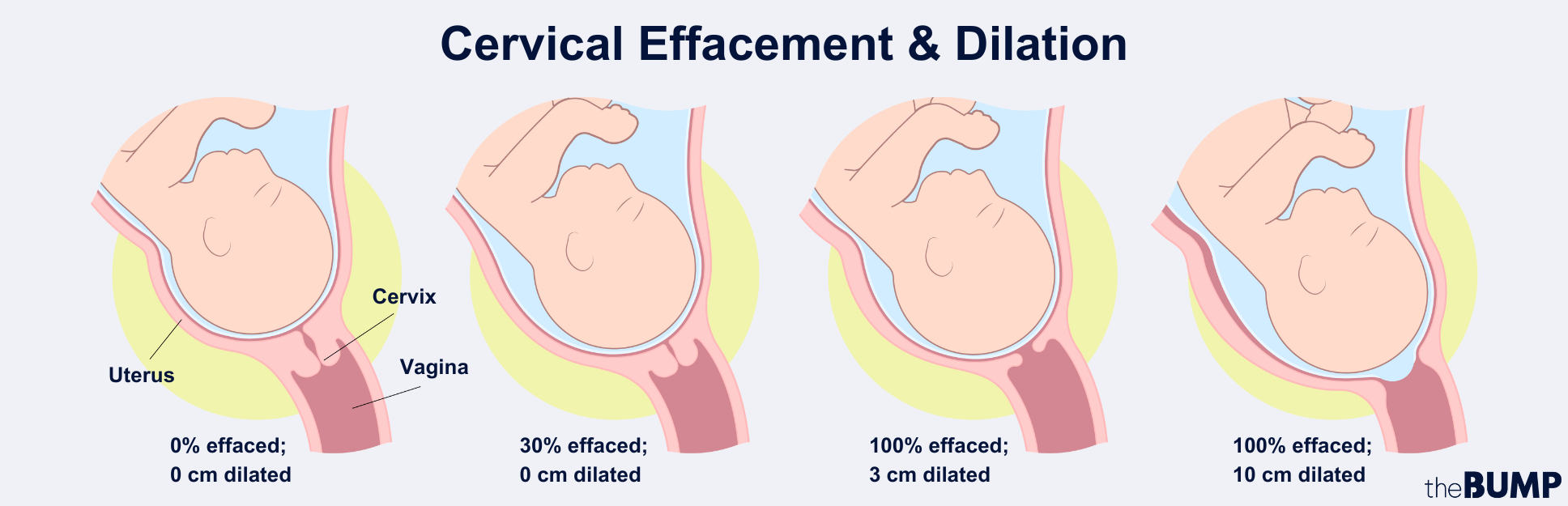
Effacement is usually measured in percentages from 0 to 100 percent, where the cervix is long and thick at 0 percent and very thin and ready for delivery at 100 percent effacement, Thiel explains. Doctors measure effacement by feeling your cervix. “We use our fingers and determine the effacement by percentages or centimeters,” Greves adds. “You can feel it and assess the thickness by putting your fingers in and feeling how thick the cervix is against the head of the baby.”
There’s no precise way for doctors to know exactly what percent effaced you are at any given moment—they can just estimate it by feel. Since there’s no definitive gauge, doctors may measure differently. Because of this, “if you have the same provider measuring it, you can get a more accurate measure,” explains Michael Cackovic, MD, a maternal-fetal medicine physician at Ohio State University Wexner Medical Center.
Unfortunately, there’s no exact timeline for when cervical effacement will start. “It’s unpredictable and can begin days or weeks before labor begins,” says Sherry Ross, MD, an ob-gyn and women’s sexual health expert. However, because baby can’t be delivered until your cervix is fully effaced and thinned out, your provider will likely start checking your cervix for effacement and dilation close to the time you become full term.
Effacement is a measure of how thin your cervix is, but dilation is how much your cervix has widened, going from 0 centimeters (closed) to 10 centimeters (fully dilated). “We can’t talk about effacement without talking about dilation, as they work together during labor,” says Melissa May Deer Pelletier, DO, an ob-gyn at Northwestern Medicine Central DuPage Hospital. “The uterus needs to have regular contractions that allow pressure to be placed on the cervix, which will thin (efface) the cervix and open (dilate) the cervix.” Providers generally want your cervix to be 100 percent effaced and 10 centimeters dilated before you start pushing, Pelletier adds.
Below, a handy chart to help you visualize how how cervical effacement and dilation occur, as well as how both work together to help deliver baby:
While you can’t feel your cervix thinning, you might pick up on a few cervical effacement symptoms. Some potential symptoms of your cervix softening include:
- Pelvic pressure. When your cervix effaces, you may feel pressure down there, Thiel says. The pressure from baby’s head could contribute to the thinning of your cervix and may cause some discomfort.
- Increased vaginal discharge: You might also notice an increase in cervical mucus or discharge, some of which may be slightly blood-tinged, Ross notes. This increase may also correlate with the loss of your mucus plug.
- Cramps: “It may feel kind of crampy,” Cackovic says. But he notes these cramps will likely be closer to menstrual pain than true labor pain. Alongside cramps, you may also experience Braxton Hicks contractions as the body prepares for labor.
- Feeling baby drop: This occurs as the cervix effaces and decreases in length. If you feel baby sitting lower in your pelvis it likely means delivery’s coming sooner rather than later.
“If you experience any unusual symptoms, you can have your healthcare provider do a pelvic exam to see if you have any cervical effacement,” Ross says. It’s also important to note that cervix effacement can happen without any symptoms, so don’t be alarmed if you don’t experience the above, Pelletier and Ross add.
Has your doctor told you you’re slightly effaced? That’s exciting news—but if you’re wondering “how long does effacement take?,” the answer is somewhat less encouraging. Suffice to say, it depends. As with most things related to labor, it can be slow and steady, fast and furious or somewhere in between. “Every patient has a different experience with timing of cervical change,” Thiel says. “Some pregnant patients have a thin cervix and stay dilated for weeks at a time before contractions and labor develop. Other patients have a long and thick cervix and progress into labor very quickly, over a few hours.”
Per Cleveland Clinic, some reasons why effacement may be happening slowly include:
- Contractions that are weak
- If baby’s too big
- If your pelvis is too small
- If the birth canal is too small
- If baby isn’t in the ideal head-down position
Are there ways to speed up effacement?
While there are no guaranteed methods, Cleveland Clinic recommends getting up and moving around to help speed things up. Ross also suggests staying active, exercising and doing pelvic tilts. But beyond some physical activity, there’s not really anything you can do on your own to speed up effacement. Your doctor, however, may consider using certain medications if your cervix isn’t effacing quickly enough or if you’re induced. “Many of the medications are given orally, vaginally or in an IV,” Thiel says.
As for any DIY tricks for accelerating effacement you find online, Pelletier says they don’t really do anything. “Beyond medical interventions offered during an induction process, there isn’t much evidence to support other methods to speed up effacement while waiting for labor to happen once a patient is 37 weeks or after,” she says.
Can you be effaced but not dilated?
Cervical effacement and dilation go hand in hand; you need both to happen in order to deliver baby vaginally. But they don’t always occur at the same time. So, yes, it’s possible to be effaced but not dilated, Thiel says. (You can also be dilated but not effaced.) “Typically, first time moms will efface and then dilate, whereas moms who have had vaginal deliveries or dilated before can dilate before their cervix will efface,” Pelletier says.
Frequently Asked Questions
If your cervix is soft, how long until labor?
“The cervix can be soft for days and weeks without going into labor,” Ross says, adding you can also go into labor without any cervix effacement. “Having a soft cervix doesn’t necessarily mean you’ll be going into labor in a timely manner.” Labor is a cocktail of several factors, including cervical effacement, dilation, hormonal changes and more.
Cervical effacement gets you closer to labor and delivery. It might be a quick process or a gradual one; there’s really no telling how soon you’ll be fully effaced. Try to be patient and listen to your body. It won’t be long now!
Please note: The Bump and the materials and information it contains are not intended to, and do not constitute, medical or other health advice or diagnosis and should not be used as such. You should always consult with a qualified physician or health professional about your specific circumstances.
Plus, more from The Bump:
Michael Cackovic, MD, is a maternal-fetal medicine physician at Ohio State University Wexner Medical Center. He has over 20 years of experience and earned his medical degree from Drexel University College of Medicine.
Christine Greves, MD, FACOG, is an ob-gyn at the Winnie Palmer Hospital for Women & Babies in Orlando. She received her medical degree from the University of South Florida College of Medicine.
Melissa May Deer Pelletier, DO, is an ob-gyn at Northwestern Medicine Central DuPage Hospital. She received her degree from Des Moines University College of Osteopathic Medicine and completed her residency from University of Nebraska Medical Center College of Medicine.
Sherry Ross, MD, is an ob-gyn, women’s sexual health expert and author of She-ology: The Definitive Guide to Women’s Intimate Health. Period. and She-ology, The She-quel: Let’s Continue the Conversation. She earned her medical degree from New York Medical College.
Lisa Thiel, DO, is an ob-gyn specializing in maternal-fetal medicine at Spectrum Health. She earned her medical degree from Philadelphia College of Osteopathic Medicine and completed residency at Michigan State University College of Osteopathic Medicine.
American College of Obstetricians and Gynecologists, Preterm Labor and Birth, April 2023
Cleveland Clinic, Effacement, May 2022
Learn how we ensure the accuracy of our content through our editorial and medical review process.
Navigate forward to interact with the calendar and select a date. Press the question mark key to get the keyboard shortcuts for changing dates.