






























What to Know About Placental Abruption


When it comes to pregnancy and birth, things don’t always go according to plan. Hiccups happen—as do more serious complications. One potential problem that can arise in the later stages of pregnancy is called placental abruption; it’s when the placenta separates from the uterine wall, and it can have considerable consequences for you and baby. The reassuring news is that it’s not very common, and with diagnosis and care, outcomes generally improve. Ready to get the full lowdown? Here’s what to know about placental abruption causes, symptoms and treatment.
Placental abruption is a condition that happens when the placenta, the organ that connects baby’s umbilical cord to your uterus, detaches from the uterine wall before or during birth, notes the ACOG (American College of Obstetricians and Gynecologists). An abruption can happen anytime after 20 weeks, adds Lena Merjanian, MD, an ob-gyn and assistant professor at Rutgers Robert Wood Johnson Medical School in New Jersey.
Types of placental abruption
There are two main types of placental abruption, says Michael Cackovic, MD, a maternal-fetal medicine physician at The Ohio State University Wexner Medical Center:
- Partial placental abruption. This happens when the placenta doesn’t completely detach from the uterine wall.
- Complete placental abruption. Also known as a total placental abruption, this happens when the placenta completely detaches from the uterine wall.
Cleveland Clinic notes that the more severe the separation, the more it affects the amount of oxygen and nutrients baby gets, and the amount of bleeding a pregnant person experiences. That said, placental abruptions either present as revealed abruptions, which is when you have bleeding that you can see, or concealed placental abruptions, which is when there’s no visible sign of vaginal bleeding, explains Cackovic.
How common is placental abruption?
Placental abruption is relatively uncommon. Statistics vary, but the Cleveland Clinic notes that placental abruption happens in about 1 percent of pregnancies.
Placenta previa vs. abruption
Placenta previa is another complication that can happen with the placenta, but it’s different from a placental abruption. “Placenta previa is an abnormal location of the placenta which covers the cervical opening,” explains Merjanian. “You can have bleeding with placenta previa as the uterus enlarges,” adds Cackovic. “But abruption is the placenta separating, wherever it is.”
Technically, anyone can experience placental abruption during pregnancy. However, according to the Mayo Clinic, there are a few factors that can raise the risk of experiencing the complication, including:
- A history of placental abruption
- High blood pressure or preeclampsia
- Rupture of the membranes
- Trauma to your abdomen (i.e. being hit in the stomach)
- Smoking during pregnancy
- Cocaine use
The most common placental abruption symptoms are vaginal bleeding and cramping in the third trimester, Cackovic says. Signs of placental abruption may also include:
- Painful contractions
- Back pain
- Less fetal movement than usual
- A uterus that feels firm and rigid
It’s also important to keep in mind that while there can be bleeding with placental abruption, it doesn’t always happen.
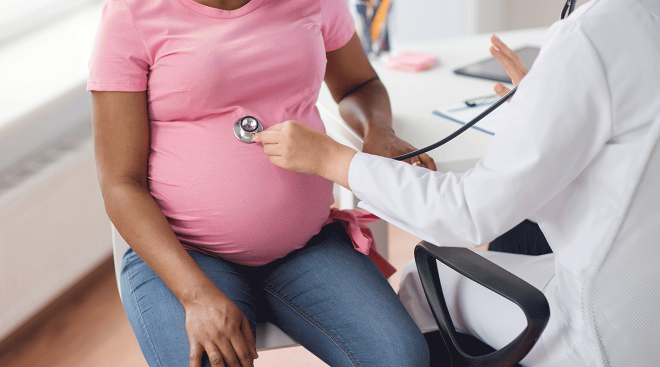
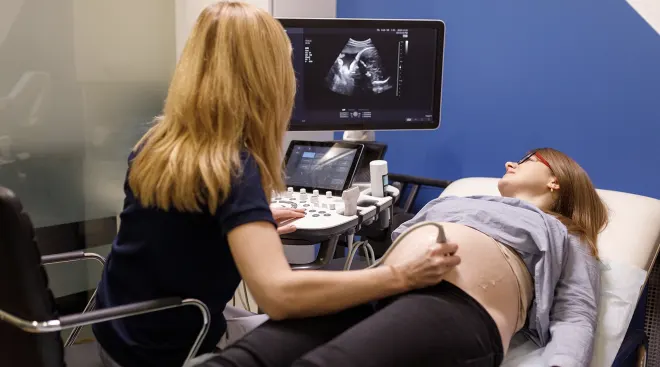
Placental abruption is usually diagnosed during a physical exam. Symptoms and your medical history may flag a potential placental abruption, and your doctor will do their due diligence. They may want to perform an ultrasound to try and locate the source of bleeding. That said, Merjanian notes that an ultrasound may or may not show the abruption.
Treatment for placental abruption can vary based on what kind of abruption you have and how far along you are in your pregnancy. “It depends on gestational age, fetal heart rate and whether baby is tolerating the abruption or not,” Cackovic says. “Mom and baby can generally tolerate up to a 25 percent abruption.” If your doctor determines that you and baby are fine, they may put you on careful monitoring and give you steroid medication to help speed up baby’s development in case they need to be delivered early.
On the other hand, if your doctor determines that your well-being or the health of baby is at risk—and you’re far enough into pregnancy—they may try to move things along. “If someone comes in at 39 weeks with a placental abruption, we’ll deliver,” says Cackovic.
What happens if you experience placental abruption during pregnancy?
If you suspect you’re having a placental abruption, Cackovic recommends going to your nearest hospital. “Just go in. It’s important,” he says. Again, your care team will determine the best course of action based on your specific circumstances.
What happens if you experience placental abruption during labor?
Placental abruption can happen in labor, and next steps depend on how you and baby are faring. “If there’s maternal or fetal instability, a c-section may be necessary,” Merjanian says. “But if Mom and baby are well, labor can continue.”
There’s a range of outcomes, and that means it can impact babies differently depending on the type of placental abruption you experience.
Placental abruption can affect baby’s heart rate, cause low oxygen levels, preterm birth and asphyxia, Merjanian says. Suffice it to say, it can be serious. But baby can also be fine with a placental abruption—a lot depends on your personal situation, Cackovic reiterates.
Again, the consequences can vary. If your doctor determines that the abruption is relatively small, and you and baby seem to be doing well, it may mean nothing for your birth experience and health, says Cackovic. But if you experience excessive blood loss, it can lead to a condition called disseminated intravascular coagulation (DIC), which can have serious repercussions, such as shock, kidney issues, respiratory distress syndrome and multi-organ failure, Merjanian says. It sounds scary, but this is why your provider will keep a close eye on you and make informed decisions.
It can be hard to prevent placental abruption in all cases, Merjanian says. However, she recommends doing your best to maintain normal blood pressure, and avoiding smoking and drug use to lower the risk. “Everything else is outside the power of the patient,” Cackovic says. That said, if you’ve experienced placental abruption in a previous pregnancy, know that you’re at greater risk; make sure your doctor is aware of your history.
Placental abruption can be serious for Mom and baby. The best thing you can do is stay on top of your regular prenatal appointments, and talk to your provider about any symptoms or concerns.
Please note: The Bump and the materials and information it contains are not intended to, and do not constitute, medical or other health advice or diagnosis and should not be used as such. You should always consult with a qualified physician or health professional about your specific circumstances.
Plus, more from The Bump:
Michael Cackovic, MD, a maternal-fetal medicine physician at The Ohio State University Wexner Medical Center. He earned his medical degree from the MCP Hahnemann University College of Medicine in Philadelphia.
Lena Merjanian, MD, is an ob-gyn and assistant professor at Rutgers Robert Wood Johnson Medical School in New Jersey, where she also earned her medical degree.
American College of Obstetricians and Gynecologists, Bleeding During Pregnancy, August 2022
Cleveland Clinic, Placental Abruption, July 2021
Mayo Clinic, Placental Abruption, February 2022
Learn how we ensure the accuracy of our content through our editorial and medical review process.
Navigate forward to interact with the calendar and select a date. Press the question mark key to get the keyboard shortcuts for changing dates.