






























What Are Braxton Hicks Contractions?



Contractions are a normal part of childbirth, but before “real” labor starts, you may experience “false” labor contractions, also known as Braxton Hicks contractions. While contractions of any kind are never fun, Braxton Hicks contractions are generally harmless (discomfort aside)—they’re just your body’s way of warming up for birth.
Determining whether you’re going into labor can be confusing, especially if it’s your first pregnancy. You might feel like you’re about to have a baby, only for the doctors or nurses to tell you that you aren’t actually experiencing labor contractions yet. So what gives? Below, we tapped experts to answer all your questions about Braxton Hicks contractions, from what they are to how to get relief.
Braxton Hicks contractions are irregular contractions that can happen on and off before you’re actually in labor. Your uterus is a muscle, and anything that irritates that muscle can cause it to contract, says Jessica Shepherd, MD, an assistant professor of clinical obstetrics and gynecology and director of minimally invasive gynecology at the University of Illinois College of Medicine at Chicago. In fact, some experts suggest that Braxton Hicks contractions help tone the muscles of your uterus to help prepare your cervix for birth—think of them as practice for the real deal.
Braxton Hicks contractions are common, but not everyone experiences them. Braxton Hicks contractions can be subtle, and some pregnant people don’t even realize they’re having them, says Sherry A. Ross, MD, a women’s health expert and author of She-ology: The Definitive Guide to Women’s Intimate Health. Period.. Of course, as with all things pregnancy, labor and pain, it’s a subjective experience. For others, Braxton Hicks contractions can be quite uncomfortable.
Pain aside, these contractions don’t cause labor, says Christine Greves, MD, an ob-gyn at the Winnie Palmer Hospital for Women & Babies in Orlando, Florida. Labor contractions, on the other hand, are associated with cervical changes that mean your body is preparing to deliver a baby. Braxton Hicks contractions are just annoying and create a lot of ambiguity: Are you in labor or is this fake? In fact, “Braxton Hicks contractions are commonly referred to as ‘false labor’ because they can present very similarly to the sensations of true labor contractions,” adds Meleen Chuang, MD, an ob-gyn and medical director of women’s health at the Family Health Centers at NYU Langone.
If you’re wondering how you’ll know if you’re experiencing real labor pains or Braxton Hicks, you’re no doubt curious to know “what do false contractions feel like?” The American Pregnancy Association (APA) notes Braxton Hicks contractions are usually an uncomfortable tightening that starts at the top of the uterine muscles and spreads down. Braxton Hicks contractions generally make your uterus feel like “a very tense basketball,” Greves says.
Are Braxton Hicks painful?
Everyone experiences these contractions differently; some women may feel a little uncomfortable, as if they’re having mild menstrual cramps, while others may actually be in pain. “Anywhere between discomfort and pain can be characterized as Braxton Hicks contractions,” Shepherd says.
Where do you feel Braxton Hicks?
Wondering where you might feel Braxton Hicks contractions? According to Cleveland Clinic, like menstrual cramps, they’re typically felt toward the front of the abdomen, rather than in your lower uterus or lower back.
How early can Braxton Hicks start? You can experience Braxton Hicks contractions at any point in your pregnancy—and the APA notes they can start as early as the second trimester. But they’re most common toward the end of the journey in the third trimester. You’re also more likely to experience them at the end of the day.
“The duration of Braxton Hicks contractions can vary from person to person,” Chuang says. According to the APA, each contraction can last between 15 and 30 seconds, but some may last as long as two minutes. You may experience them for a brief period, and they’ll likely be irregular before easing up, tapering off and disappearing.
There are several possible causes for Braxton Hicks contractions—after all, they’re a product of pregnancy. But experts say these are a few key explanations for why they occur:
- Dehydration: This is a major cause of Braxton Hicks contractions, according to Greves. “The area in the brain that tells your uterus to contract is right next to the area of the brain that tells you when you’re thirsty,” she says—and sometimes when you’re thirsty, it can activate the area of your brain that causes contractions. Moreover, muscle cramps—including those in your uterus—are more likely to occur when you’re dehydrated, Shepherd says.
- A urinary tract infection: Urinary tract infections (UTIs) can cause Braxton Hicks contractions, Shepherd says. Luckily, they go away after the UTI is treated.
- Too much activity: Sometimes overdoing it can spark Braxton Hicks contractions, Greves says. Even just standing on your feet or walking around for an extended period of time can trigger them. If you’ve been active and you start experiencing contractions, she recommends resting for a bit to see if they subside.
- Sex: Some women experience Braxton Hicks contractions during or after sex. When you orgasm, your body releases oxytocin, a hormone that makes your muscles contract. Plus, all that physical activity can prompt contractions. They’re usually mild and should resolve soon after.
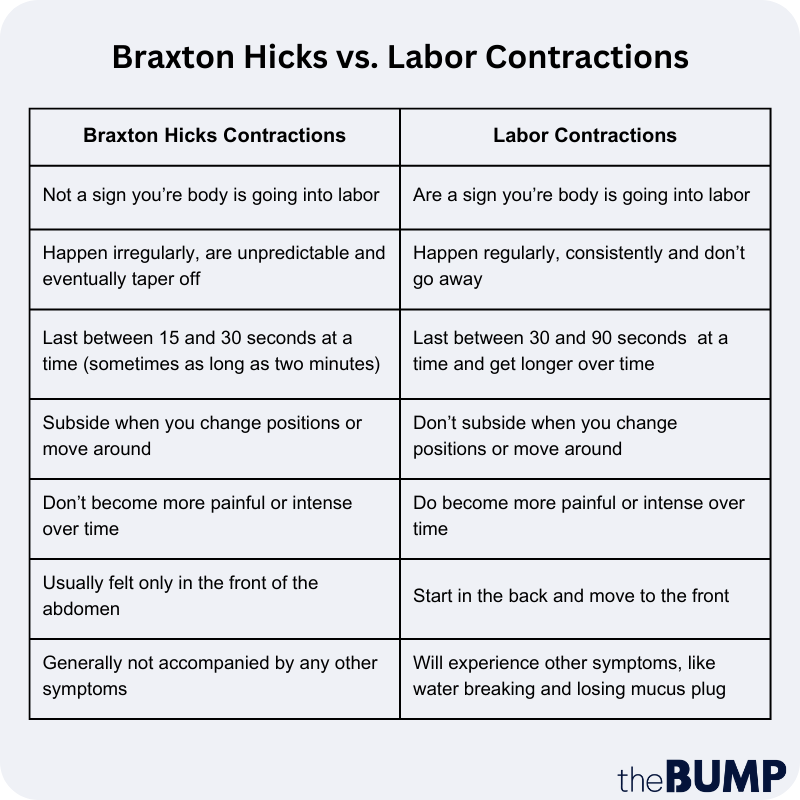
The main difference between Braxton Hicks contractions and real contractions? Braxton Hicks aren’t a sign that you’re going into labor, while labor contractions indicate that your body is preparing to give birth and will ultimately lead to cervical dilation and other markers of labor progression.
So how do you know when it’s just Braxton Hicks versus the real deal? One of the key differences between Braxton Hicks contractions vs. real contractions is that they’re irregular, while labor contractions are consistent. Braxton Hicks contractions usually last between 15 and 30 seconds at a time (but sometimes as long as two minutes), and they often subside when you change positions or activity. Real contractions, on the other hand, are more consistent, lasting anywhere between 30 and 90 seconds (and getting longer over time). They also don’t ease up when you move around.
Pain levels are a factor too. Unlike Braxton Hicks, “real uterine contractions start like menstrual cramps and continue getting more intense and painful,” Ross says. Plus, Braxton Hicks contractions are usually felt only in the front, whereas real contractions start in the back and move to the front.
When you’re having real contractions, you may experience other symptoms too, such as your water breaking or losing your mucus plug.
How to tell the difference between Braxton Hicks and labor contractions
The best remedies for Braxton Hicks contractions will vary depending on what’s causing them and how intense they feel. Here are some things to try:
- Drink fluids. Given that dehydration is a major cause of Braxton Hicks contractions, drinking some water should help them subside, Shepherd says.
- Rest. If you experience contractions after exercising or moving around a lot, it’s important to put your feet up. “Listen to your body,” Greves says. If you feel like you’re contracting more with exercise, take it easy.
- Change your position. If your contractions don’t seem to be tied to exercise, getting up and moving around to change your position may help relieve them. For example, walking may be helpful if you’ve been sitting or lying in one position for too long.
While Braxton Hicks contractions are incredibly common, Greves says, it’s important to flag any contractions you experience to your doctor, who will want to confirm that you’re not in labor or preterm labor. You should also contact your doctor if you’re experiencing any of the following symptoms:
- More than eight contractions in under an hour, or painful contractions that occur every 10 minutes or less
- Leaking amniotic fluid
- Vaginal bleeding
- Decreased fetal movement
Braxton Hicks can be confusing, but these contractions aren’t usually cause for alarm. Of course, if you’re still not sure whether you’re experiencing fake-out contractions or real ones, don’t hesitate to contact your doctor. And if they are practice contractions, don’t worry—baby will be arriving in due time.
Can Braxton Hicks contractions mean labor is coming soon?
Braxton Hicks contractions are not an indication of labor. “While Braxton Hicks contractions can be uncomfortable and may increase in frequency as you near your due date, they’re not necessarily an indication that labor is coming soon,” Chaung says. “If you have concerns or are unsure, it’s always best to consult with your healthcare provider.”
Does baby move around during Braxton Hicks contractions?
It’s true that babies can and do move around during Braxton Hicks contractions. “They can sometimes cause baby to shift or move within the womb,” Chuang explains. “However, the movement during Braxton Hicks contractions is generally not as pronounced or intense as the movements you may feel during active labor.”
Please note: The Bump and the materials and information it contains are not intended to, and do not constitute, medical or other health advice or diagnosis and should not be used as such. You should always consult with a qualified physician or health professional about your specific circumstances.
**Plus, more from The Bump:
Meleen Chuang, MD, is an ob-gyn and medical director of women’s health at the Family Health Centers at NYU Langone. She earned her medical degree from SUNY Stony Brook.
Christine Greves, MD, FACOG, is an ob-gyn at the Orlando Health Winnie Palmer Hospital for Women & Babies in Orlando, Florida. She received her medical degree from the University of South Florida College of Medicine.
Sherry A. Ross, MD, is an ob-gyn and women’s health expert at Providence Saint John’s Health Center in Santa Monica, California, and author of She-ology: The Definitive Guide to Women's Intimate Health. Period. and She-ology, The She-quel: Let's Continue the Conversation.
Jessica Shepherd, MD, FACOG, is an ob-gyn and minimally invasive gynecologic surgeon at Baylor University Medical Center in Dallas, Texas. She is also the founder of Her Viewpoint, an online women’s health forum that focuses on addressing taboo topics in women’s health in a comfortable setting. She received her medical degree from Ross University School of Medicine in 2005.
American Pregnancy Association, Braxton Hicks Contractions – Causes, Symptoms & Pain Relief, 2023
Cleveland Clinic, Braxton Hicks Contractions, May 2022
Learn how we ensure the accuracy of our content through our editorial and medical review process.
Navigate forward to interact with the calendar and select a date. Press the question mark key to get the keyboard shortcuts for changing dates.