





























The Baby Blues Survival Guide



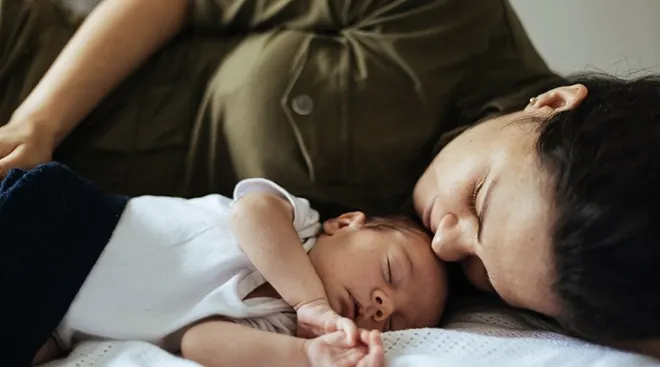
You excitedly count down the weeks until you meet baby, expecting to feel euphoric once that moment arrives. But by the time you come home from the hospital, you feel…“eh.” What gives? Say hello to the baby blues. Before you give yourself the “worst mom ever award” for feeling down after giving birth, know that this is completely normal. According to the National Institute of Mental Health, as many as eight out of 10 moms will get the baby blues. Considering that you just spent 40 weeks growing a human in your belly and probably even sweated through a multi-hour labor, only to embark on a sleepless marathon of feedings and diaper changes, it makes sense that you’re not exactly radiant. Even the cutest baby can’t always compensate for this level of physical and mental exhaustion. Still, there are plenty of things you can do to brighten up. Read on!
Baby blues are irregular mood changes that can start shortly before or anytime after childbirth, but usually set in between a week and a month after delivery and generally last for less than two weeks. The reality of attending to a new baby that monopolizes all your time and energy can leave you feeling irrationally upset and frustrated. However, unlike full-blown postpartum depression, the negative feelings you get with the baby blues aren’t continuous, and you should still experience moments of joy.
Besides the obvious baby blues causes—mental and physical exhaustion—there are physiological triggers as well. These include:
• Hormonal shifts and chemical imbalances. During and after pregnancy, hormonal changes naturally make you more vulnerable to mood shifts. Remember feeling super-emotional during the first trimester (thank you, progesterone)? Cortisol, the stress hormone, gradually rises during pregnancy, peaks at delivery and drops to baseline level within the first three days postpartum, according to a BMC Pregnancy and Childbirth article. Hormones aren’t the only things to blame when it comes to the baby blues, however; research shows that an increase of monoamine oxidase (MAO-A), an enzyme that helps break down “feel-good” chemicals like serotonin and dopamine in the brain, may work as a catalyst in that uneasy feeling. Immediately after delivery, the new mother’s estrogen production plummets to pre-pregnancy levels, says Michael Silverman, PhD, assistant professor of psychiatry at Icahn School of Medicine at Mount Sinai in New York City. Simultaneously, MAO-A increases and essentially destroys those feel-good chemicals in the brain.
• Inflammation. Your body undergoes tremendous change and repair during pregnancy—you just grew and birthed a baby, after all. As a result, “there is a profound immunologic response,” Silverman says. “And we know there’s a strong relationship between inflammation and depression.” As with an extreme case of the flu, wear and tear on your body can have an effect on your brain, leaving you crabby and in cognitive disarray—what we call the baby blues.
Most women are just trying to survive after being catapulted into motherhood full force. Not surprisingly, the feelings of worry and fatigue that arise are natural. They also underlie the most common baby blues symptoms. These include:
- mood swings
- crying spells
- anxiety
- difficulty sleeping
- loneliness
- brain fog
One way you can tell whether you have the baby blues or postpartum depression is that with the baby blues, you should see an improvement in mood in about two weeks. Without this relief, or with a worsening of symptoms, it’s possible you might have postpartum depression.
Up to 15 percent of women experience postpartum depression within the first six months—though, “it often occurs in the first three months postpartum and may have started during pregnancy,” says Tiffany Moore Simas, MD, associate professor of ob-gyn, pediatrics and psychiatry at the University of Massachusetts Medical School in Worcester, Massachusetts. You can be prone to minor and major depressive episodes for the first year post-childbirth. In addition, if you have a history of depression, you’re more than 20 times more likely to suffer from postpartum depression compared to women without such a history, according to a recent Depression and Anxiety study. If you also had pregestational diabetes, an inflammatory disease, there’s an additional 1.5-fold increased risk for postpartum depression.
Finally, while baby blues symptoms are mild, that’s just not the case with the symptoms for postpartum depression. “The baby blues are temporary and manageable,” says Sherry A. Ross, MD, author of She-ology: The Definitive Guide to Women’s Intimate Health. Period. and a Santa Monica, California-based ob-gyn. “Postpartum depression makes all the desperate feelings more intense and debilitating to a point where you’re unable to perform your daily routine, including caring for your baby.” The symptoms for postpartum depression include:
- profound sadness
- loss of interest in things you enjoyed before the baby
- unrelenting guilt
- extreme anxiety
- helplessness
- worthlessness
- change in energy and concentration
- poor appetite and sleeping habits
By definition, in order to be considered depressed, the symptoms need to last at least two weeks, but if you notice these behaviors and you feel concerned, talk to your doctor right away—especially if you have a history of depression. “The consequences to the mother and the child are not worth ‘waiting and seeing’ whether the baby blues go away on their own,” Silverman says. “Once real depression hits, the mother is not in a position to get help on her own.”
The delicate period post-childbirth may seem permanent, but you’ll eventually find your rhythm. Chances are, your mom did that, and so did her mom and so on. Realizing this will help you through it.
Those who are naturally more anxious because of a genetic predisposition or history of mental illness may not be able to cope with the baby blues without the help of a medical professional, psychotherapy or medication. “I would encourage any woman not to ask but tell her ob-gyn that she’s worried about her emotional state,” Moore Simas recommends.
Doctors will typically wait after the two-week mark to start prescribing breastfeeding-safe antidepressants and antianxiety medications to help moms manage their baby blues. “Keeping your postpartum routine and bonding rituals with your baby is vital in the treatment process,” Ross says.
Unless you’re dealing with unbearable and disruptive baby blues symptoms, you may be able to alleviate the baby blues with a few helpful coping techniques:
• Seek support. Without a strong social network of family and friends, it’s easy to feel helpless and alone. When you feel like everything is on you, even a minor annoyance, like yet another poopy diaper, can quickly lead to a full-blown breakdown. Seek out someone who can say, “‘I get it.” That should be your partner, but it can also include a best friend or another family member. When you have the baby blues, these people “let you be as emotional as you want,” Silverman says. And they help “facilitate the adjustment much quicker.”
• Build a mommy network. Reach out to friends or moms from your prenatal classes. Chances are they’re going through something similar or, better yet, have already overcome the challenges of the baby blues and can offer solid advice. Pursue empathetic friends, since they’re most helpful during stressful times. Online communities like The Bump Message Board and Postpartum Progress are also great resources for connecting with moms who may also be grappling with the baby blues.
• Engage in skin-to-skin contact. The Journal of Obstetric, Gynecologic, & Neonatal Nursing found that moms who engaged in six hours of skin-to-skin contact with baby in the first week reported fewer depression behaviors. What’s more, those who did skin-to-skin contact for even three hours a day reduced infant crying by 43 percent.
• Practice mindfulness. Staying in tune with yourself through mindfulness (awareness during a particular moment) is said to reduce the likelihood of postpartum depression, according to new research from the University of Wisconsin-Madison and the University of California, San Francisco. Engage in meditation or yoga, even if it’s just for a few minutes a day.
• Sleep. Deprive any healthy person of sleep, and you’ll notice moodiness. Deprive a new mom juggling everything, and you have potential chaos. To help lessen the baby blues effects, try to sleep when baby sleeps—the dishes and laundry can wait.
• Set realistic expectations. Motherhood is often not how you dreamed it to be while pregnant. Once you’re home from the hospital you’ll likely feel scattered, so instead of trying to do things “just so,” focus on getting into a rhythm—even if that rhythm involves walking around like a zombie.
Updated September 2017
Please note: The Bump and the materials and information it contains are not intended to, and do not constitute, medical or other health advice or diagnosis and should not be used as such. You should always consult with a qualified physician or health professional about your specific circumstances.
Navigate forward to interact with the calendar and select a date. Press the question mark key to get the keyboard shortcuts for changing dates.