



























Serenity Now! How to Sleep Train Baby



“You’ll never sleep again.” Sound familiar? There’s a reason this cliche is often repeated at baby showers: In those first few months of parenting, before baby has an established sleep-wake cycle and needs to be fed only every few hours, sleep is fractured and confusing, with a long stretch just as likely to occur midafternoon as it is in the middle of the night. And that’s normal. But once baby is a few months old—after she’s dropped those middle-of-the-night feedings and has established a somewhat predictable sleep-wake cycle—sleep training her can help your whole family get some much-needed nighttime shut-eye. Here, what you need to know before choosing the best sleep-training method for your family.
Simply put, sleep training—also called sleep teaching or sleep learning—is the process of helping your infant learn how to fall asleep and stay asleep. It’s also become a pretty controversial topic, with experts and parents speaking for or against various sleep-training techniques. “It’s like talking politics,” says TJ Gold, MD, a pediatrician at Tribeca Pediatrics in New York City. “But there’s no one right way to get your child to sleep through the night. There are a lot of different ways.”
The benefits of sleep training baby can be substantial: Everyone in the household will be well rested, and sleep is essential to baby’s development. A landmark 2007 study from the National Institutes of Health suggested that critical brain-development periods are dependent on adequate sleep. “Sleep training baby may not be fun, but I always tell families that it’s not dangerous, and developing good sleep hygiene is, in my opinion, one of the best things you can do for your child,” Gold says.
That said, sleep training isn’t a must-do for everyone, and many families who skip sleep training go on to have a child who learns to sleep through the night on her own. “It’s your family and your child, and I think there’s a misconception that pediatricians will force sleep training on your family, when that’s not the case,” Gold says. Experts emphasize that the best approach to sleep training is the one that fits your family.
“I knew I didn’t want to sleep train, so I co-slept with my son until he was about 5 months old,” says Corinna, a mom of two. “At 5 months, I was able to put him in a room on his own, but I would attend to him if he cried. By 10 months, he was sleeping through the night on his own. Maybe I was lucky, but I felt like what worked best for our family was following his lead.”
Exhausted parents may be eager to get training underway—so how do you know when to start sleep training? “Most infants are ready for some sort of sleep training at 4 to 6 months,” says Lauren Kupersmith, MD, a clinical instructor at the department of pediatrics at NYU Langone Medical Center. “While some pediatricians adhere to the guidelines that infants are ready to be sleep trained when they achieve a particular weight, I feel it’s much more appropriate to wait until they are developmentally ready to self-soothe, at about 4 months old.”
Still, there’s no right time to begin sleep training baby. While 4 months is a great time to consider starting, experts stress that you haven’t missed out if you don’t sleep train until baby is 10 months, a year or even older.
“We didn’t sleep train until our son was 18 months and we moved into a two-bedroom apartment so he could have his own room,” says Robin, a mom of two. “We did a ‘sleep lady shuffle’ method, and he caught on pretty quickly.”
While you may have read up on various sleep training methods while pregnant or in the early weeks of baby’s life, it’s a good idea to speak with your pediatrician before you start. For example, if your child is gaining weight slowly or was a preemie, he may not be ready to drop a nighttime feeding and may need a sleep-training schedule that’s adapted to a few middle-of-the-night wake-ups.
There are various schools of thought on sleep training. Some sleep-training methods fall under the umbrella of “gentle sleep training,” which generally means you’re still going to pick up, rock and soothe baby if she cries. Other methods, often under the “extinction” label, advise parents to let baby self-soothe for the entire night and not open the door until morning. Neither of these methods are right or wrong—it all depends on what works best for you and your family.
Some moms have found working with a sleep coach or joining a Facebook sleep group to be helpful for support, tips and advice. “We ended up hiring a sleep coach, which was helpful because she could talk us through any questions or issues and show that we were on the right track,” Robin says.
Sleep training methods
All sleep-training methods have pros and cons, says Vanessa Vance, a child-sleep consultant in Austin, Texas, so it’s important to suss out which one is best for you. “When I work with a family, we discuss what their needs and goals are. Some families may not want any crying, so a gradual approach may work best,” she says. Here, an overview of some of the most popular sleep-training methods:
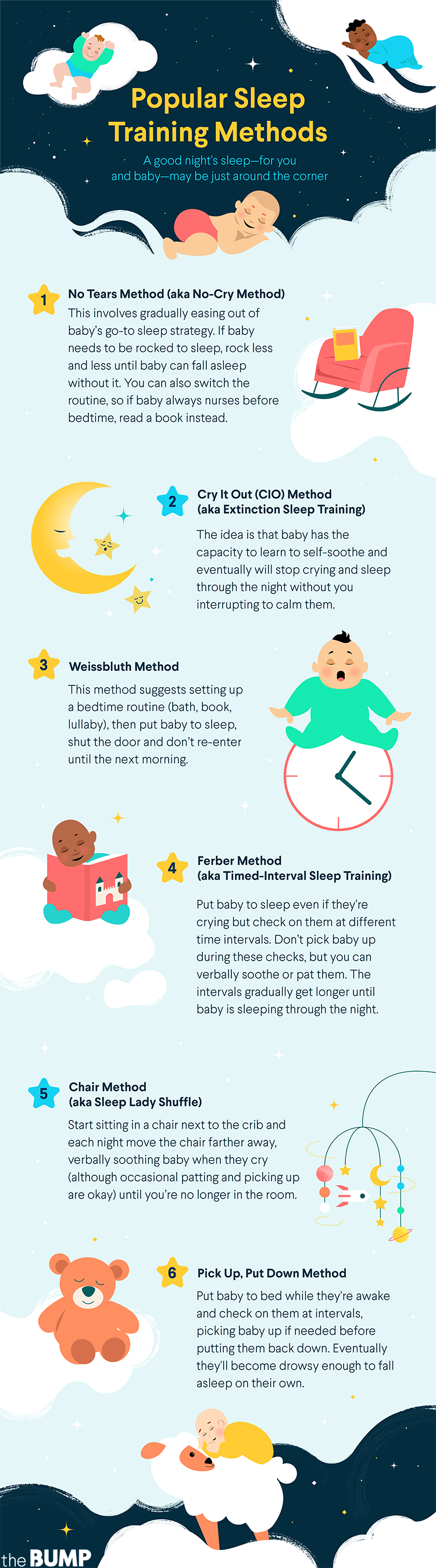
• No tears method. Created by sleep expert Elizabeth Pantley, this technique, also known as the no-cry method, involves subtly shifting your child’s sleep habits. For example, one trick, known as “fading,” suggests gradually easing out of baby’s go-to sleep strategy. For instance, if she always needs to be rocked, you would rock less and less until you can put her down to sleep without any rocking. Another technique, called substitution, switches out the routine—so if baby always nurses before bedtime, read a book instead.
• Cry It Out (CIO) method. As the name suggests, sleep training baby with this method involves teaching her to soothe herself by not interfering while she’s trying to fall asleep. Also known as extinction sleep training, the idea is that baby has the capacity to learn to soothe herself and eventually will stop crying and sleep through the night.
• Weissbluth method. This sleep-training method suggests you set up a bedtime routine (bath, book, lullaby), then put baby to sleep, shut the door and don’t re-enter until the next morning. “I tried this, and the first night was awful,” says Jen, a mom of one, who did the Weissbluth method at 4 months. “I turned on the shower and sat in the bathroom so I wouldn’t hear my son cry. But I was watching the baby monitor and saw that after an hour, he found his thumb and fell asleep. The next night was maybe 40 minutes of crying, then 20 minutes the night after that. He’s always happy in the morning, and I feel this was the right choice.”
• Ferber method. Also known as timed-interval sleep training, modified sleep training or graduated extinction sleep training, parents using this method put baby down to sleep even if he’s crying, then return to check on him at different time intervals —every five, 10 and 15 minutes, and so on. You don’t pick baby up during these checks but can verbally soothe or pat him. Gradually, the intervals will get longer until eventually baby is sleeping through the night. “We did Ferber once my son was 8 months old. He got the hang of it pretty quickly and has been sleeping on his own for 10 to 12 hours ever since,” says Anika, a mom of one.
• Chair method. Also called the sleep lady shuffle or gradual withdrawal and popularized by Kim West, LCSW-C, author of Good Night, Sleep Tight, this method starts with you sitting in a chair next to baby’s crib. Each night, you move the chair farther away from the crib, verbally soothing or shushing baby when she cries (although occasional patting and picking up are okay) until you’re no longer in the room. This method can be helpful for older babies and toddlers who may suffer from separation anxiety and can understand that Mom and Dad are just on the other side of the door, but it also works for younger babies.
• Pick-up-put-down method. In this sleep-training method, you put your child to bed while he’s awake and check on him at gradual intervals, as you do with the Ferber method. Unlike with Ferber, you can pick him up and comfort him, holding him for a few minutes before putting him down. Eventually baby will become drowsy enough to fall asleep on his own.
Check out The Bump’s Sleep Training Infographic:
How long does sleep training take?
Whatever you decide, remember that sleep training baby is different for everyone. You’ll always hear about a baby who was able to sleep through the night from day one, but don’t expect overnight miracles. So how long does sleep training take? Experts say most strategies will take a week or longer to implement, and sticking them out is key to making them work.
Whatever approach you use, even if you decide to use a combination of sleep-training methods or none at all, here are a few tips on making sure it sticks.
• Know there will be regressions. Teething, illness, vacation and routine shifts all can lead to poor sleep, and that’s all right, Vance says. “Often, you may have to go back to training for a day or two to get back on track, but you won’t lose ground. If your child has been trained to be a good sleeper, one week off schedule because of vacation won’t change that.”
• DIY methods work. Don’t love the rigidity of a particular method? Modify it to suit your own family’s circumstances. Sometimes, a sleep coach can be helpful to come up with modifications that won’t affect the goal of getting baby to sleep through the night, but it’s fine to mix and match until you find a strategy you’re comfortable with. “I don’t think I’ve ever loved and loathed anything as much as I do sleep training. We did it with my son because he was still waking up every three hours at 3.5 months old, and I felt it was more out of habit,” says Margaret, a mom of one. “My husband and I decided that we valued teaching him self-soothing and that in the long run it was worth some short-term effort. I did a ton of research and came up with our own plan—similar to Ferber, but our time limits of letting him fuss weren’t as rigid. It worked, and he’s been a solid sleeper since.”
• Stick with it. One bad night of crying in the first week of sleep training baby doesn’t mean that it’s not working. “If you find you’re not having success with the strategy you’re trying, it’s okay to try something new. Just make sure you give it at least one week before switching, or you may never know,” Kupersmith says.
• Don’t compare. Even within families, what worked best for one kid may not work for another, Kupersmith says. And don’t compare yourself with what your friends or people on Facebook groups are doing. Again, every family’s sleep needs are different.
• Have a solid bedtime routine. Experts say that regardless of which sleep-training method you use, having a stable bedtime—between 5:30 and 7:30 p.m. for infants, Vance suggests—and a steady routine are key. Whether it’s bath, book, lullaby, bed or a different sequence, doing the same thing every evening is part of the bedrock of good sleep hygiene. Blackout curtains and a white noise app may also help.
It’s okay if you’re not ready. You aren’t missing out on sleep training if you skip it at 4 months: You truly can start sleep training at any age, even in the toddler years, although experts say it’s smart to be aware of developmental milestones and adjust baby’s sleep schedule accordingly. For example, the week baby learns to walk may be tough to implement a sleep-training schedule, and even a sleep-trained baby may see a regression simply because he’s going through such a developmental shift.
• Having trouble? A consultant can help. Sleep consultants and coaches familiar with different sleep-training methods can answer questions, troubleshoot problems and help you find a method that works with your family. But before you enlist the aid of a sleep coach (whose services can range from a phone consultation to an overnight analysis at your house), look into their qualifications. There’s no national governing body for sleep coaching, but there are various programs that provide certification. For example, the Family Sleep Institute is a national training program; Gentle Sleep Coaches, led by Kim West, is another. Before you commit, find out about the coach’s training and credentials, and ask for referrals and experiences from past clients.
Updated September 2019
Please note: The Bump and the materials and information it contains are not intended to, and do not constitute, medical or other health advice or diagnosis and should not be used as such. You should always consult with a qualified physician or health professional about your specific circumstances.
Navigate forward to interact with the calendar and select a date. Press the question mark key to get the keyboard shortcuts for changing dates.